Product innovation is the lifeblood of any successful business, driving growth and ensuring long-term competitiveness. This guide delves into the multifaceted world of product innovation strategies, providing a framework for generating, developing, launching, and iterating on new products. We’ll explore various approaches, from incremental improvements to radical disruptions, and examine how to effectively align innovation with market needs and technological advancements.
The journey will encompass idea generation, competitive analysis, agile development methodologies, and post-launch evaluation, ultimately equipping you with the tools to navigate the dynamic landscape of product innovation.
We will examine diverse strategies, from brainstorming and market research to detailed product development lifecycles and comprehensive marketing plans. This exploration will encompass both theoretical frameworks and practical examples, illustrating how successful companies have implemented these strategies to achieve remarkable results. The ultimate goal is to empower you with a clear understanding of the entire product innovation process, enabling you to develop and launch successful products that resonate with your target market.
Defining Product Innovation Strategies
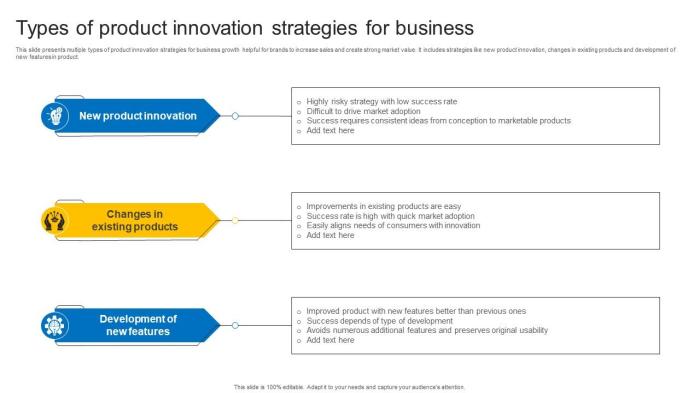
Product innovation strategies are the blueprints companies use to develop and launch new products or significantly improve existing ones. They encompass a range of activities, from identifying market opportunities and developing new technologies to launching marketing campaigns and managing the product lifecycle. Effective strategies are crucial for sustained growth and competitive advantage in today’s dynamic marketplace.Core principles underpin effective product innovation strategies.
These include a deep understanding of customer needs and market trends, a robust process for idea generation and selection, a commitment to collaboration and cross-functional teamwork, and a culture that embraces experimentation and risk-taking. Furthermore, successful strategies prioritize efficient resource allocation, rigorous testing and evaluation, and a flexible approach to adapting to changing circumstances.
Types of Product Innovation
Product innovation can be categorized in several ways, with three prominent types being incremental, radical, and disruptive. Incremental innovation involves making small, iterative improvements to existing products. For example, a smartphone manufacturer might release a new model with a slightly faster processor and a better camera. Radical innovation, conversely, introduces entirely new products or technologies that significantly alter the market landscape.
The invention of the iPhone is a classic example of radical innovation. Disruptive innovation creates new markets and value networks, often initially targeting low-end or underserved segments before eventually displacing established market leaders. The emergence of digital photography disrupting traditional film photography exemplifies this.
A Framework for Classifying Product Innovation Strategies
A useful framework for classifying product innovation strategies considers the interplay between market needs and technological capabilities. This framework can be visualized as a two-by-two matrix. One axis represents the level of unmet market need (high vs. low), while the other axis represents the level of technological advancement required (high vs. low).
This allows companies to strategically position their innovation efforts based on their capabilities and market opportunities. For example, a company with strong technological capabilities might focus on radical innovation in a market with high unmet needs, whereas a company with limited technological resources might prioritize incremental innovation in a market with low unmet needs.
Comparison of Product Innovation Approaches
| Strategy Name | Description | Advantages | Disadvantages |
|---|---|---|---|
| Incremental Innovation | Small, iterative improvements to existing products. | Lower risk, faster time to market, lower development costs. | Limited potential for significant market disruption, may not address fundamental customer needs. |
| Radical Innovation | Development of entirely new products or technologies. | High potential for market disruption, significant competitive advantage, potential for high returns. | High risk, high development costs, longer time to market, potential for market failure. |
| Disruptive Innovation | Creating new markets and value networks, often initially targeting low-end segments. | Potential to create entirely new markets, high long-term growth potential. | High risk, initial slow adoption, potential for cannibalization of existing products. |
| Open Innovation | Collaborating with external partners to develop new products. | Access to external expertise and resources, faster innovation cycles, reduced development costs. | Potential for loss of intellectual property, challenges in managing external collaborations. |
Idea Generation and Selection
Developing successful product innovations hinges on a robust process for generating and selecting promising ideas. This involves a blend of creative thinking, rigorous analysis, and a deep understanding of the market landscape. Effectively navigating this stage ensures resources are focused on concepts with the highest potential for return.Idea generation and selection are iterative processes, often involving feedback loops and adjustments based on new information.
A systematic approach ensures that biases are minimized and that the most viable options are prioritized for further development. This section details the methods and criteria involved in this crucial phase of product innovation.
Methods for Generating Innovative Product Ideas
Effective idea generation requires a multi-faceted approach, combining brainstorming techniques with thorough market research. Brainstorming sessions, when facilitated properly, can unlock a wealth of creative solutions. Market research, on the other hand, provides the crucial data needed to validate these ideas and assess their market potential.
- Brainstorming Techniques: Techniques like mind mapping, SCAMPER (Substitute, Combine, Adapt, Modify, Put to other uses, Eliminate, Reverse), and reverse brainstorming encourage participants to think outside the box and generate a wide range of ideas. Mind mapping visually organizes ideas, while SCAMPER provides a structured approach to modifying existing products or processes. Reverse brainstorming focuses on identifying potential problems with existing products to spark innovative solutions.
- Market Research Approaches: Market research is critical for validating ideas and understanding customer needs. This includes conducting surveys, focus groups, competitive analyses, and analyzing sales data. Surveys provide quantitative data on customer preferences, while focus groups offer qualitative insights into customer behavior and motivations. Analyzing sales data can reveal trends and identify unmet needs in the market.
Evaluating and Selecting Product Ideas
Once a pool of ideas has been generated, a rigorous evaluation process is necessary to select the most promising candidates. This involves assessing feasibility, market potential, and return on investment (ROI).
- Feasibility Assessment: This involves determining whether the idea is technically feasible, considering factors such as available technology, manufacturing capabilities, and regulatory compliance. For example, a new type of battery might be deemed infeasible if the required materials are too expensive or the manufacturing process is too complex.
- Market Potential Analysis: This involves estimating the size of the target market, the potential market share, and the expected sales volume. Market research data, including competitor analysis and customer surveys, is crucial for this assessment. For instance, analyzing the market size for electric vehicles helps determine the potential market for a new electric vehicle model.
- Return on Investment (ROI) Calculation: This involves estimating the expected costs and revenues associated with developing and launching the product. A positive ROI indicates that the investment is likely to be profitable. A detailed financial model is necessary to accurately predict the ROI for a new product.
Conducting a Competitive Analysis
A competitive analysis is a systematic process of identifying, analyzing, and comparing competitors in order to gain a competitive advantage. This informs product innovation decisions by highlighting market gaps, identifying competitive threats, and understanding the strengths and weaknesses of competitors.
- Identify Competitors: Begin by identifying all direct and indirect competitors. Direct competitors offer similar products or services, while indirect competitors offer alternatives that satisfy the same customer need.
- Analyze Competitors: Analyze each competitor’s strengths, weaknesses, market share, pricing strategies, marketing efforts, and customer base. This can involve reviewing their websites, marketing materials, and customer reviews.
- Compare Competitors: Compare the analyzed information to identify opportunities and threats. This may reveal unmet customer needs, areas where your product can differentiate itself, or potential challenges from competitors.
- Develop Strategies: Use the competitive analysis to inform your product innovation strategies. This may involve focusing on a specific niche, developing unique features, or adopting a different pricing strategy.
Key Criteria for Assessing the Viability of New Product Ideas
Several key criteria should be considered when evaluating the viability of new product ideas. These criteria provide a structured framework for making informed decisions and prioritizing resources effectively.
- Market Need: Does the product address a real and significant market need?
- Technical Feasibility: Is the product technically feasible to develop and manufacture?
- Financial Viability: Does the product have the potential to generate a positive ROI?
- Competitive Advantage: Does the product offer a unique value proposition or competitive advantage?
- Regulatory Compliance: Does the product comply with all relevant regulations and safety standards?
- Scalability: Can the product be scaled to meet potential demand?
- Market Size and Growth Potential: What is the size of the target market, and what is its growth potential?
Case Studies
Successful product innovation isn’t just about having a great idea; it’s about strategically developing and launching that idea into the market. This section examines three diverse case studies, illustrating how different innovation strategies led to significant market success. Each case highlights key decisions, challenges overcome, and the ultimate impact on the product’s trajectory.
Successful Product Innovation Case Studies
The following case studies showcase diverse approaches to product innovation, demonstrating the importance of understanding your target market and adapting strategies accordingly. They highlight the crucial role of market research, iterative development, and effective marketing in translating a novel idea into a commercially successful product.
| Company | Product | Innovation Strategy | Results |
|---|---|---|---|
| Apple | iPhone | Disruptive Innovation; Combining existing technologies (touchscreen, mobile internet) in a novel way to create a superior user experience. Focused on user-centric design and a seamless ecosystem. | Revolutionized the mobile phone industry, establishing Apple as a dominant player in the smartphone market. Generated billions in revenue and reshaped consumer behavior. Created a highly loyal customer base. |
| Nintendo | Wii | Blue Ocean Strategy; Created a new market segment by focusing on motion controls and accessibility, attracting a broader audience than traditional gaming consoles. Targeted families and casual gamers. | Massive sales success, significantly expanding the gaming market. Brought new players into the gaming industry. Demonstrated the power of targeting underserved markets. |
| Tesla | Model S | Incremental Innovation and Disruptive Innovation; Improved upon existing electric vehicle technology while simultaneously disrupting the luxury car market with superior performance and technology. Focused on sustainability and high-performance. | Established Tesla as a leading electric vehicle manufacturer, influencing other automakers to accelerate their electric vehicle development. Significantly increased consumer interest in electric vehicles. Demonstrated the potential for high-performance electric cars. |
Mastering product innovation requires a holistic approach, integrating creativity, strategic planning, and a deep understanding of market dynamics. By embracing agile methodologies, prioritizing customer feedback, and continuously iterating on your products, you can build a sustainable competitive advantage. This guide has provided a roadmap for this journey, emphasizing the importance of a strong value proposition, effective launch strategies, and post-launch evaluation.
Remember that successful product innovation is an ongoing process of learning, adapting, and refining your approach based on market feedback and evolving technological capabilities. Continuous improvement is key to long-term success.
FAQs
What is the difference between incremental and radical innovation?
Incremental innovation involves making small, iterative improvements to existing products, while radical innovation involves creating entirely new products or services that disrupt the market.
How can I measure the success of my product innovation strategy?
Key Performance Indicators (KPIs) such as market share, customer satisfaction, revenue growth, and return on investment (ROI) can be used to assess success.
What role does customer feedback play in product innovation?
Customer feedback is crucial for understanding market needs and identifying areas for improvement. It should be actively sought and incorporated throughout the entire product lifecycle.
How important is market research in product innovation?
Market research is essential for identifying opportunities, understanding customer needs, and validating product concepts before significant resources are invested.
What are some common pitfalls to avoid in product innovation?
Common pitfalls include neglecting customer feedback, underestimating market competition, and failing to adapt to changing market conditions.